 Skip to content
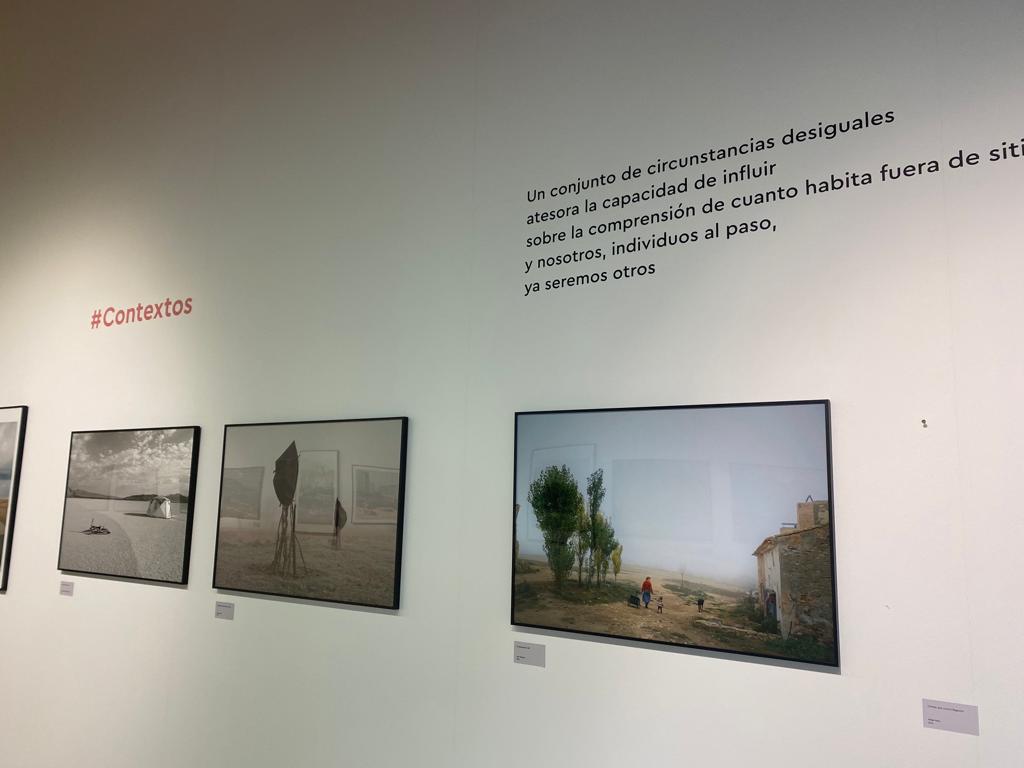
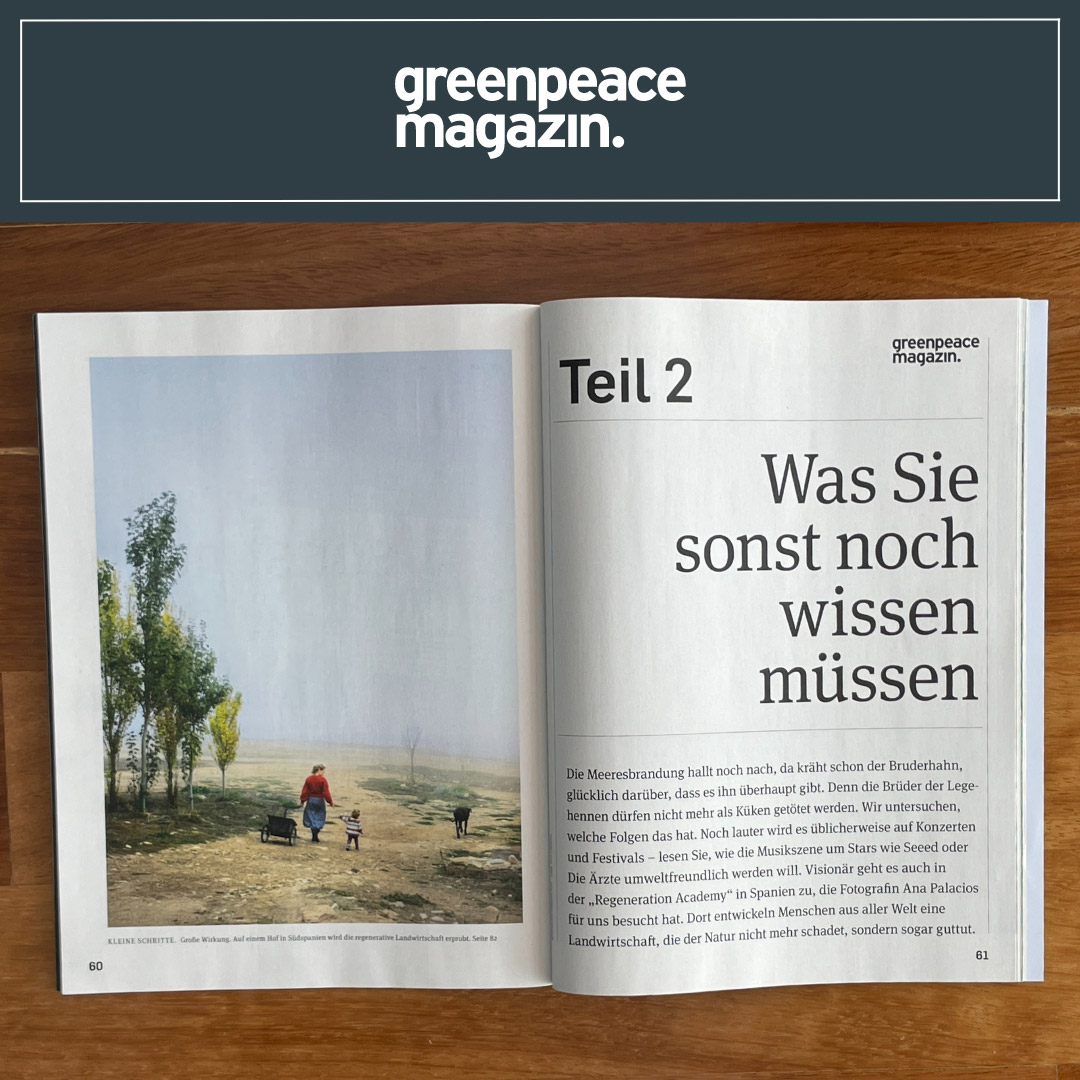
Yannieck Schoonhoven, the co-founder of the Regeneration Academy, her daughter Elena, and Taiga, the dog, walk towards their home in La Junquera farm. She came to work just a few weeks in 2016 and she decided to stay.
Yannieck Schoonhoven, the co-founder of the Regeneration Academy, her daughter Elena, and Taiga, the dog, walk towards their home in La Junquera farm. She came to work just a few weeks in 2016 and she decided to stay.
“Laboratoria” is a compilation of human-driven creative solutions addressing the challenges of the territory.
It is a visual project that documents the intersection of experimentation and knowledge to creatively address the urgent and emerging challenges of rural depopulation and environmental conservation through innovation.
The South Chapter has been carried out in different locations in Spain (Murcia, Cáceres, Cuenca, Teruel, Soria and Zaragoza).
Documentary project ongoing since 2021.
The Regeneration Academy proposes scientific, profitable and sustainable answers on regenerative agriculture.
This academy is located in one of the most desertified areas of Europe, La Junquera farm (Murcia, Spain). Since 2015, it is used as a science-based classroom of 1,100 hectares where entrepreneurs and students from all over the world come to research and experiment on location on how to restore degraded ecosystems while getting a sustainable profit through regenerative agriculture techniques having hands-on experience.
It is also a entrepreneurs’ incubator like a natural wine winery project, land artists, and a communication agency. They all live and work there, creating a cohesive young international community.

When Alfonso Chico de Guzmán decided to move from Madrid to La Junquera in 2011, his family farm for 200 years, the houses were abandoned for decades.
He restored some of them and now these are the homes for the managers of the projects that are being developed inside this farm of 1,100 ha.
When Alfonso Chico de Guzmán decided to move from Madrid to La Junquera in 2011, his family farm for 200 years, the houses were abandoned for decades.
He restored some of them and now these are the homes for the managers of the projects that are being developed inside this farm of 1,100 ha.

Rouan Fousert, a French student at the Research Program at the Regeneration Academy, swims every morning at the pond nearby the volunteers house inside the La Junquera farm while Yakie and Taiga, the dogs, hang out.
Rouan studies his Bachelor degree on International Land and Water Management at the WUR Wageningen University and Research, in the Netherlands.
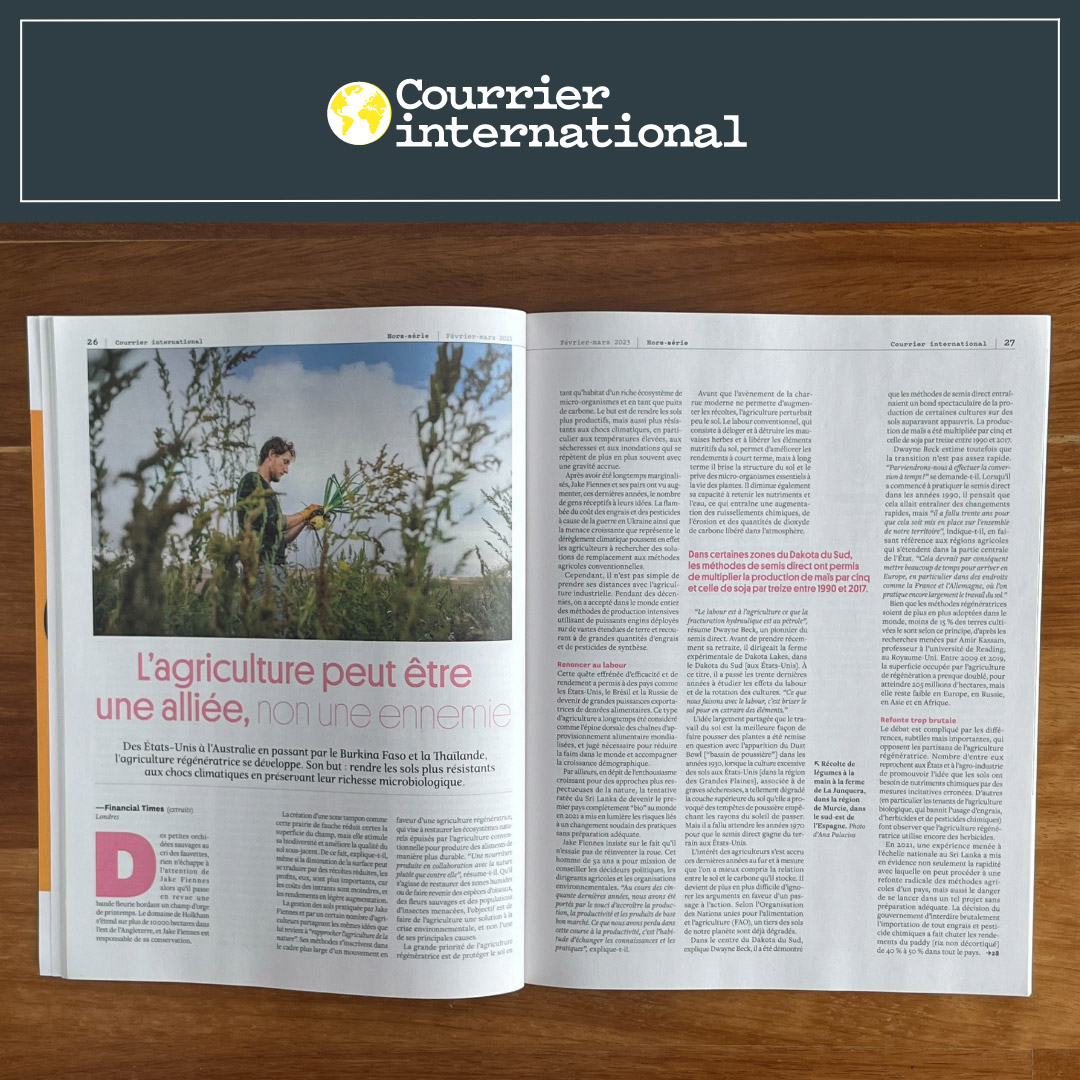
Courrier International. Special issue “Climat le temps de l’action”. February 2023

Silvia Quarta, an Italian worker at the Regeneration Academy, is in charge of the Camp Altiplano educational project, inside La Junquera farm, that also has a very low-maintenance garden.
Silvia has a degree in international relations, and a master’s degree in environmental sciences, with a specialization in water management.
She arrived at La Junquera in 2019 as a coordinator for their Camp Altiplano project. She has been coordinating reforestation actions on the farm and activities with volunteers from all over the world, creating ecosystem restoration courses, and experimenting with regenerative techniques in the five hectares of Camp Altiplano.

Dani Segura, a worker at La Junquera and collaborator with the Academy, harvests some vegetables for the open day visit, for self- consumption and also to sell to the visitors.
Dani works in La Junquera since September 2020. He has a background in viticulture and strong interest in the activities developed in the Academy.

(From left to right) Dani Segura, Chloe Durot, Jakob Drews, Jacobo Monereo, and Gabriel Molina, workers and students at the academy, are harvesting the vegetables cultivated in La Junquera.
The selection criteria are, whenever possible, to plant local varieties or non-commercial varieties. We also choose a varied assortment of different vegetables for self-consumption and to sell locally. The last criteria would be if someone from La Junquera has a
preference or a project with any particular fruit or vegetable.
(From left to right) Dani Segura, Chloe Durot, Jakob Drews, Jacobo Monereo, and Gabriel Molina, workers and students at the academy, are harvesting the vegetables cultivated in La Junquera.
The selection criteria are, whenever possible, to plant local varieties or non-commercial varieties. We also choose a varied assortment of different vegetables for self-consumption and to sell locally. The last criteria would be if someone from La Junquera has a
preference or a project with any particular fruit or vegetable.

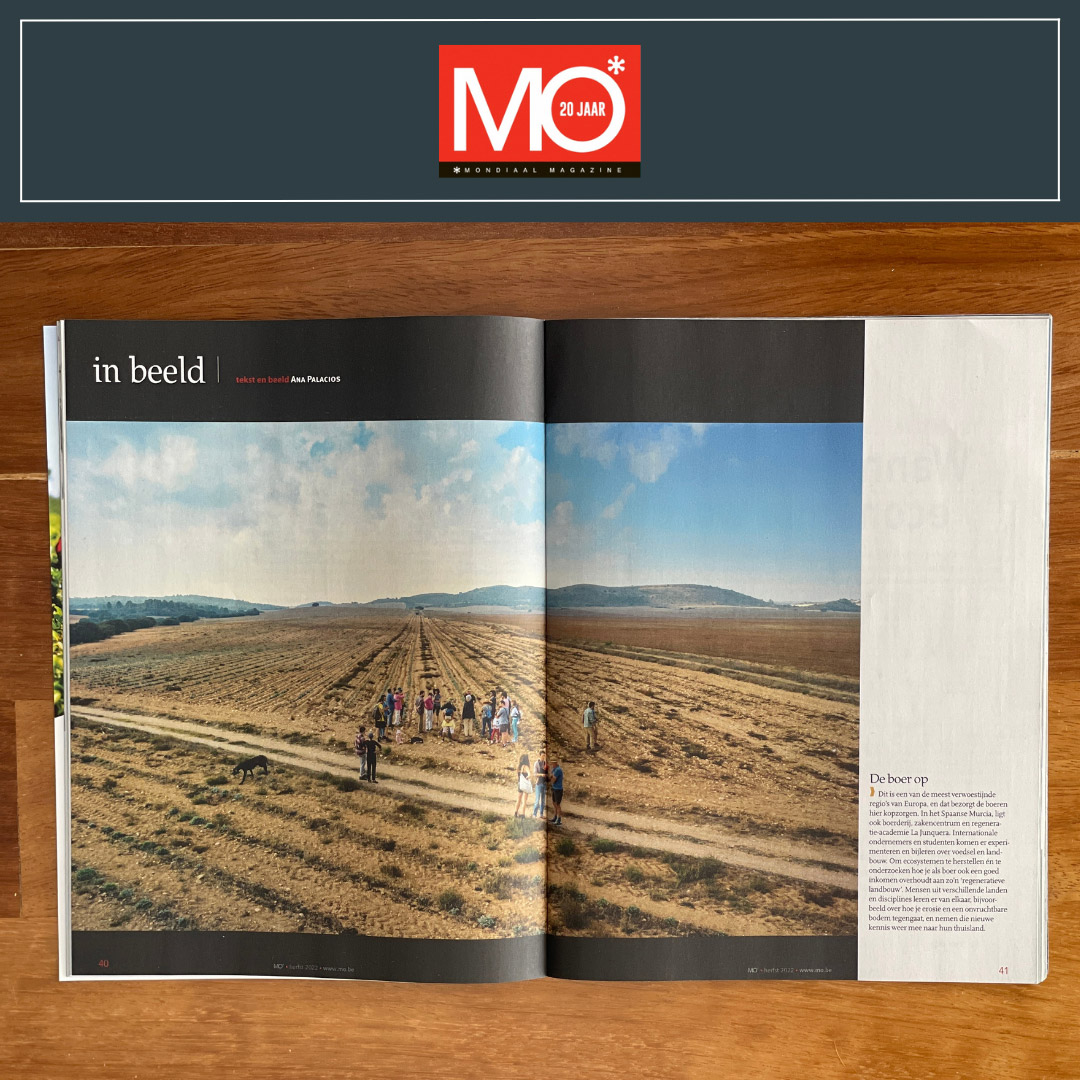
MO* Magazine. Belgium – The regeneration academy. September 2022


Yanniek takes Dartacan, a 12-year-old French saddle horse, out for half an hour a day to practice dressage.

The artist Iñigo Flores is working on his art pieces at his workshop located in La Junquera.
“I settle in the farm “La Junquera” in the Murcian steppe, a space where several projects are developed where sustainability, regenerative agriculture and art are focused on the same path. As a blacksmith when necessary, most of my time is dedicated to the interpretation and materialization of both naturalistic and humanistic ideas. Where I manage to reach a sufficient level to organize my own exhibitions in Madrid.” Iñigo Flores, artist.

“Since I wanted to show one of the most powerful parts of medieval blacksmithing, I was preparing massive iron dons to weld them to “calda”, that is to say, the ancient way of welding without electricity. It was an attempt to project some human faction in the iron, without any kind of metric, using what I had around me to then create a forest of misunderstood beings.
This particular bird has been created for my friend Pierina Seinfeld, who is dedicated to transforming individual elements and hanging them in order to find a constant moving balance between them.” Iñigo Flores, artist.
This iron bird was created by Iñigo Flores, blacksmith artist, at his workshop in La Junquera for his friend Pierina Seinfeld, who is dedicated to transforming individual elements and hanging them in order to find a constant moving balance between them.
“Since I wanted to show one of the most powerful parts of medieval blacksmithing, I was preparing massive iron dons to weld them to “calda”, that is to say, the ancient way of welding without electricity. It was an attempt to project some human faction in the iron, without any kind of metric, using what I had around me to then create a forest of misunderstood beings.
This particular bird has been created for my friend Pierina Seinfeld, who is dedicated to transforming individual elements and hanging them in order to find a constant moving balance between them.” Iñigo Flores, artist.
This iron bird was created by Iñigo Flores, blacksmith artist, at his workshop in La Junquera for his friend Pierina Seinfeld, who is dedicated to transforming individual elements and hanging them in order to find a constant moving balance between them.

Yanniek Schoonhoven holds a basket with fresh eggs just collected from their farm hens.

Jakob Drews, German, volunteers for 7 weeks at the Camp Altiplano which is the first one of the world’s 42 Ecosystem Restoration Camps, located in La Junquera and as part of the educational programs of the Academy.
Jakob studies BSc Geoecology at the University of Potsdam, in Germany. He is researching about student projects like a community garden, environment commission and founded the group “Tree.UP” to help develop a Campus where plants are seen as precious neighbors and friends.
The Camp is a 5 ha patch inside La Junquera where regenerative methods are being implemented, tested, and monitored by volunteers, where they work and live in a shared bunkhouse made from wood and straw bales.
They receive intensive workshops where they learn about the ecological, historical and social background of the land that they are in.
“In the afternoon we sat together in circles to talk about our inner motivations, about our hopes and fears for this planet, about our emotional connections and how to use them. And most importantly we shared our stories with each other, ate super great food, and had lovely nights at the fire.
Regeneration is not only planting trees, but it is also the healing of relationships with all beings including yourself through giving what you have and accepting what you receive.
I felt directly more grounded and connected to the land because I knew that these small actions can have a huge impact on every tree to survive and grow stronger. They are thankful for our work and in turn we will receive lots of tasty fruits.” Jakob Drews, volunteer at the Camp Altiplano, part of the educational projects of the Regeneration Academy.

Inés Estefanell, Bachelor in Advertising and Public Relations, lives in Madrid and teaches creativity at the University of CEU San Pablo. She re-designed La Junquera logo, designed the Regeneration Academy website, wine and cider labels, etc.
She also conducts training workshops on advertising, communication, graphic design, and branding at the Regeneration Academy to agricultural entrepreneurs and to international students.
“This a project that has strong and coherent roots and also, a clear and direct message to transmit. It is also leaded by a young team, some of them have been my friends for a long time, so I quickly understood their way of thinking and their mission. I actually share their concerns and their vision so that makes it easy to work with.
That’s how I work with La Junquera, understanding who they are, their goals and spirit, then I try to make it beautiful on the screen, paper, etc.” Inés Estefanell, art director, teacher at the Regeneration Academy.

The agriculture in the region consists mainly out of the large monocultivation of cereals, rain-fed almonds, olives and the local ‘Segureño’ sheep breed.
The main problems that are creating a dysfunctional ecosystem are related to erosion, rainwater infiltration, and lack of organic matter and fertility in our soils. That is why, they are focusing their efforts in building silt traps, swales, keyline plantations, limited tilling, and ponds.
These practices not only help to reduce erosion, improve fertility and increase water infiltration but also increase dramatically biodiversity incredibly fast.

Cows enjoy eating the sweet rests of the grapes used for the “Iberopunk” natural wine done by the “La del Terreno” winery.
La Junquera, as part of the ecosystem regeneration projects, has 22 of the 30 Murciano-Levantina cows in the world.
The plan is to save this local breed from extinction, as part of their biodiversity conservation philosophy, to preserve the local heritage. They look for near to extinction specimens that some local farmers have and, along with the genetic bank of the University of Murcia, the goal is to slowly recover this particular breed.

A pregnant cow that will give birth shortly rests in the cows warehouse at La Junquera.
La Junquera, as part of the ecosystem regeneration projects, has 22 of the 30 Murciano-Levantina cows in the world.
The plan is to save this local breed from extinction, as part of their biodiversity conservation philosophy, to preserve the local heritage. They look for near to extinction specimens that some local farmers have and, along with the genetic bank of the University of Murcia, the goal is to slowly recover this particular breed.

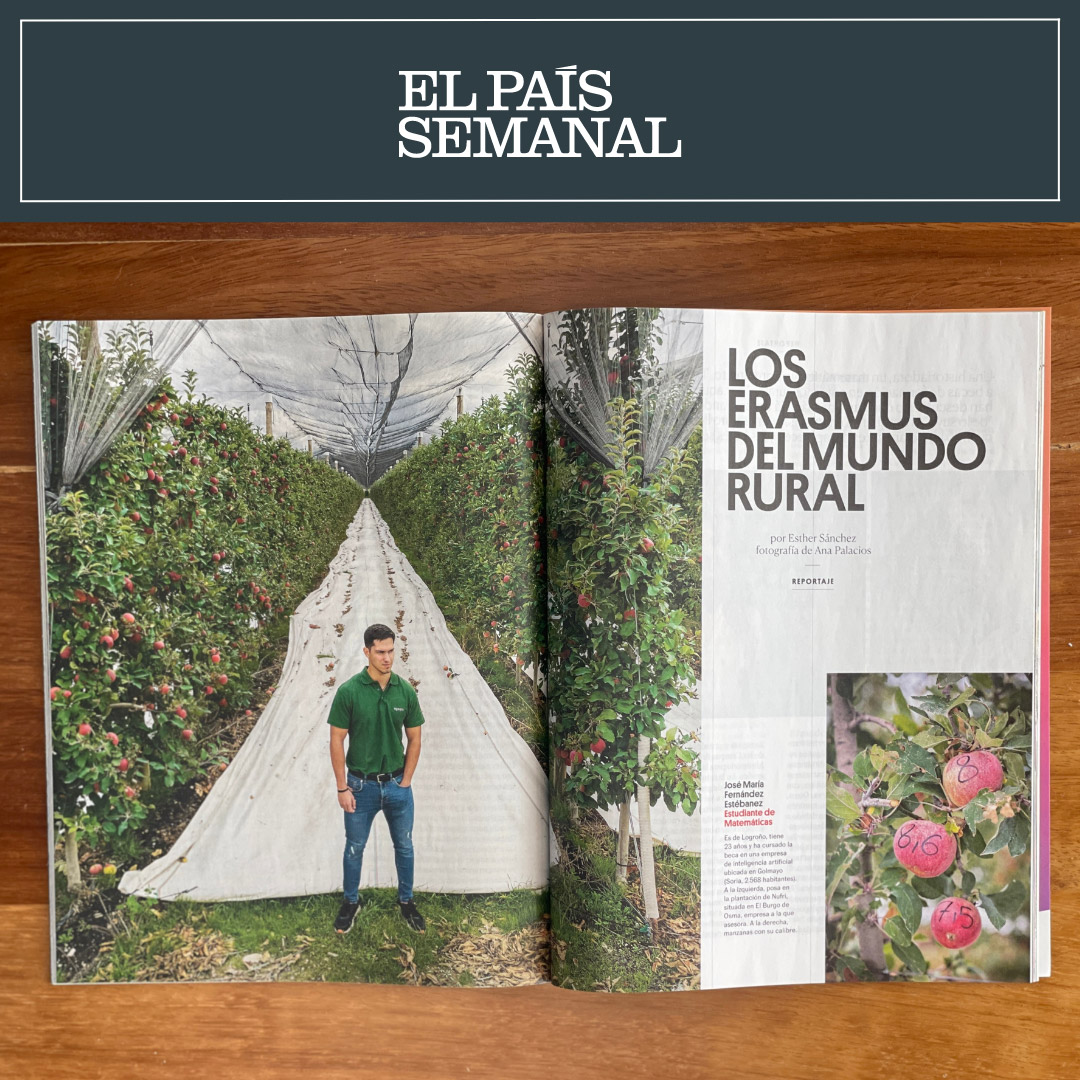
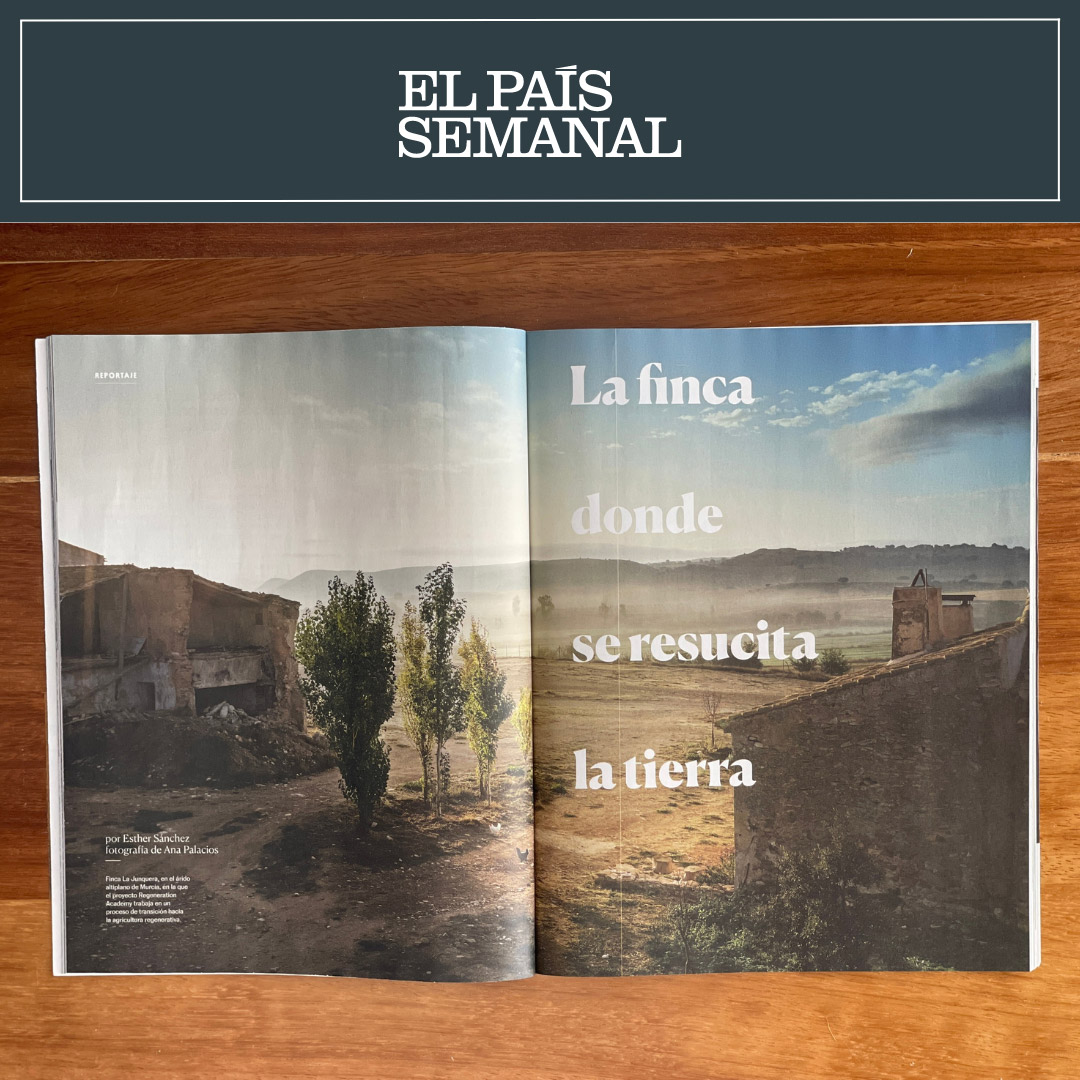
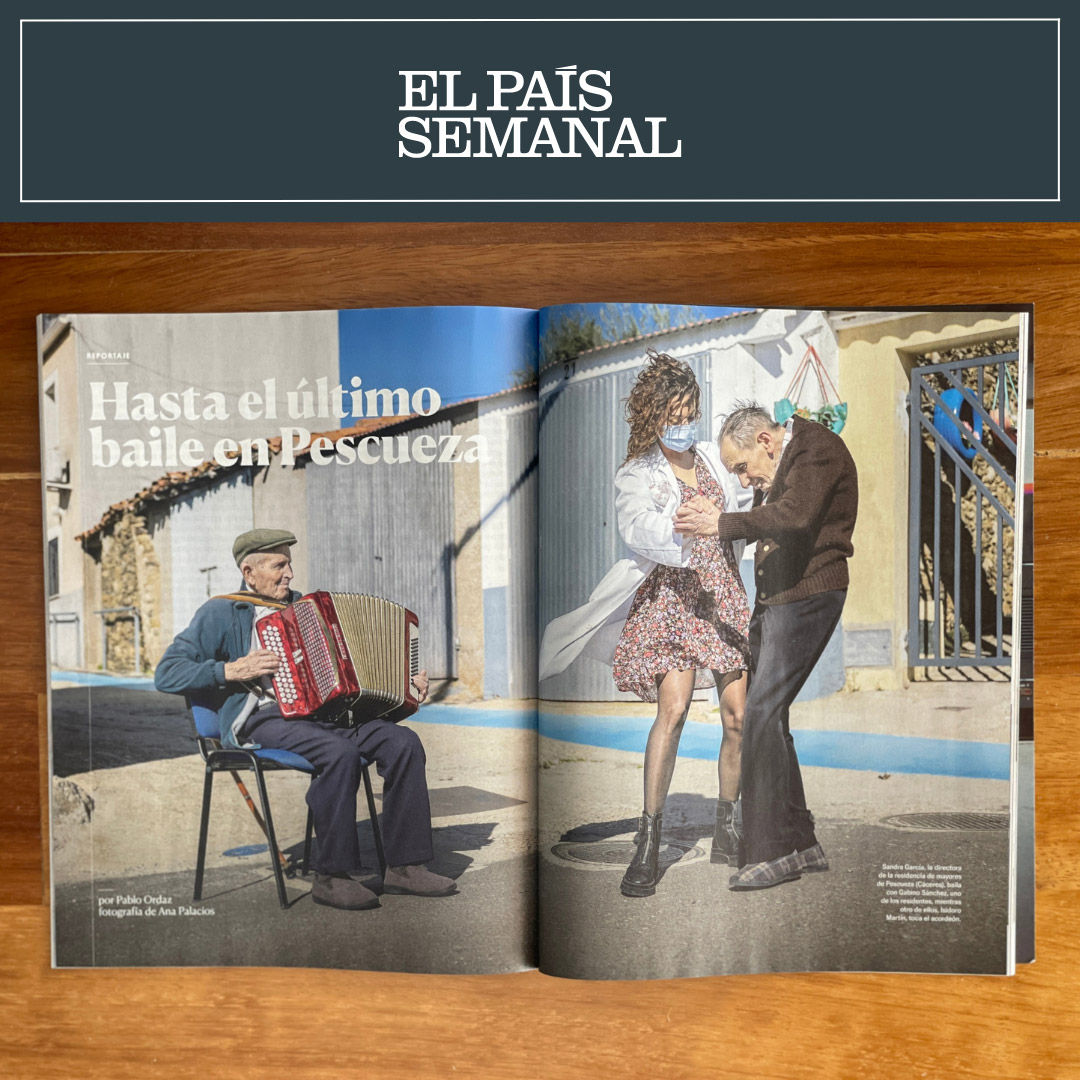
El País Semanal – Los Erasmus del Mundo Rural. January 2023

Vineyards are about to be harvested by Julia Casado and the Regeneration Academy volunteers to make the “Iberopunk” natural wine.
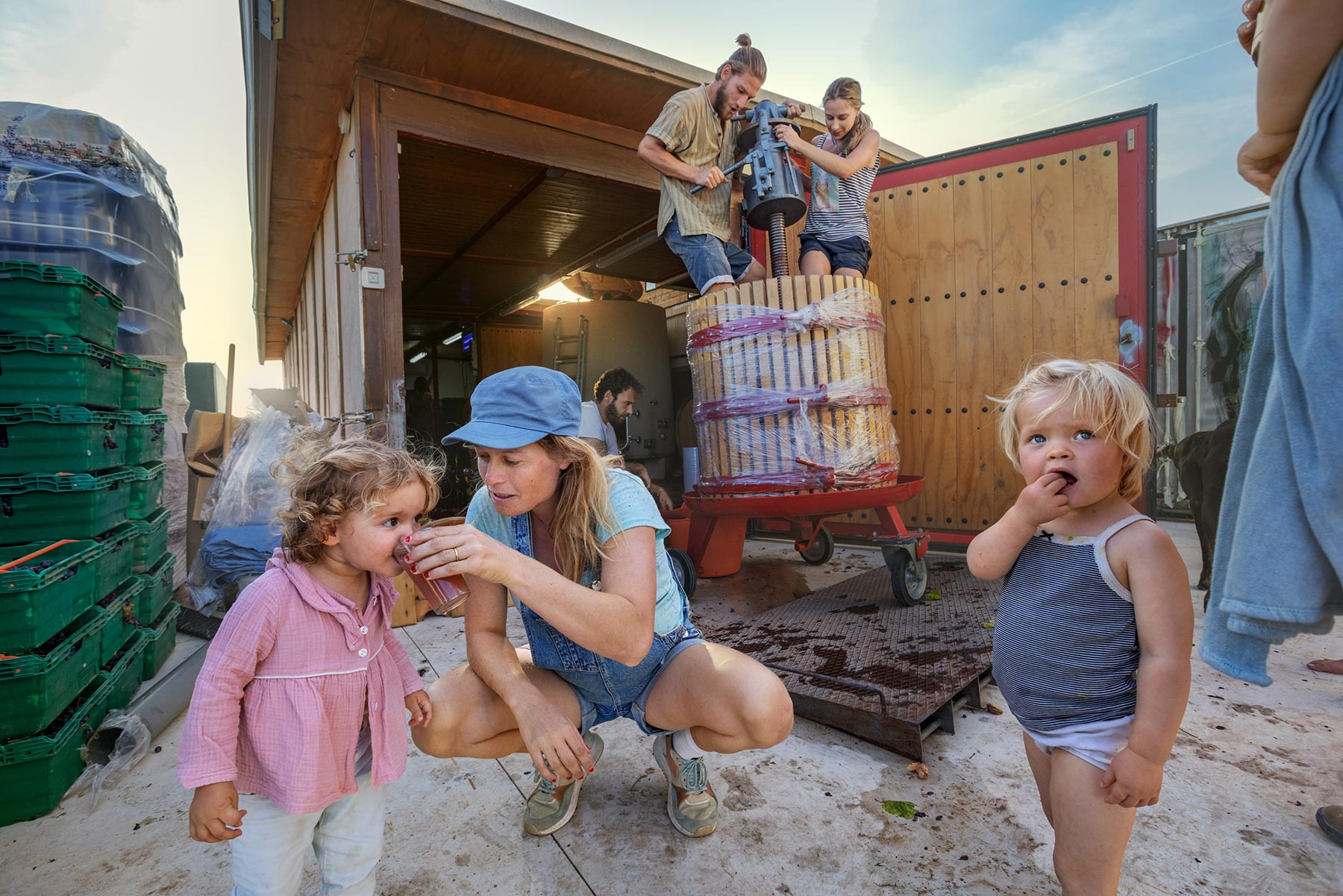
Yannieck Schoonhoven, the co-founder of the Regeneration Academy, is giving some fresh grape juice to her daughter Elena, while Jacobo Monereo, Regeneration Academy director, and volunteers Chole Durot and Jakob Drews help press the grapes.
The wine will be called “Iberopunk”. It is a sparkling wine, with a simple profile, which undergoes a second fermentation in the bottle. This type of wine is very common in Catalonia but less known in this area (South of Spain). Initially, they wanted it to be a rosé but they just decided that it is going to be a sparkling wine that will be bottled in April 2022 and will be on the market in the summer, approximately.
Yannieck Schoonhoven, the co-founder of the Regeneration Academy, is giving some fresh grape juice to her daughter Elena, while Jacobo Monereo, Regeneration Academy director, and volunteers Chole Durot and Jakob Drews help press the grapes.
The wine will be called “Iberopunk”. It is a sparkling wine, with a simple profile, which undergoes a second fermentation in the bottle. This type of wine is very common in Catalonia but less known in this area (South of Spain). Initially, they wanted it to be a rosé but they just decided that it is going to be a sparkling wine that will be bottled in April 2022 and will be on the market in the summer, approximately.

The Academy organizes an open day visit to La Junquera twice a year: During these 1-day learning journeys, the visitors get familiar with to regenerative practices. They guide the group through the farm showing practical examples and trials. Approaching general topics, describing what is La Junquera farm and the Regeneration Academy, the farm tour of regenerative agriculture experiments and their natural restoration protocols.
After the tour, lunch is catered with local products.
The Academy organizes an open day visit to La Junquera twice a year: During these 1-day learning journeys, the visitors get familiar with to regenerative practices. They guide the group through the farm showing practical examples and trials. Approaching general topics, describing what is La Junquera farm and the Regeneration Academy, the farm tour of regenerative agriculture experiments and their natural restoration protocols.
After the tour, lunch is catered with local products.

Marie Prioux, (left) is from France and she has a bookshop in Paris. She is also a basketry artist and she is visiting her friend Silvia Quarta (right), an Italian worker at the Regeneration Academy who is in charge of the educational project Camp Altiplano, is doing cane handicrafts while Julia Casado (center), winemaker, and Silvia are resting after a hard workday, at the front yard of Julia’s home inside La Junquera farm.

Julia Casado, winemaker and agricultural engineer, is an independent winegrower and founder and owner of “La del Terreno”, a small self-financed winery producing natural wines. Se designed her winery and made it energy-efficient and, thanks to its modular design, she has been able to move it to different locations and settle in La Junquera since 2020.
This is one of the independent businesses settled inside the farm as a regenerative agricultural collaboration project.
Julia studied music and, at the age of 20, she specialized in cello at the Musikhochschule in Mannheim (Germany). She was a concert cello player for some years before starting her entrepreneurship on natural wines.
El País Semanal – Los Erasmus del Mundo Rural. January 2023

La Junquera is a 1,100ha farm located in the Murcian highlands with a history of more than 200 years, it began as a hemp and esparto grass production farm. During all this time it has been transformed to become an organic farm in which regenerative agriculture techniques are implemented in more than five different types of crops, focusing on biodiversity restoration, livelihood improvement and making it viable and sustainable in the long term.
A hilly land with an average elevation of 1,100 meters. The region is characterized by a semi-arid climate and a low precipitation, mountainous terrain and a sparse population.
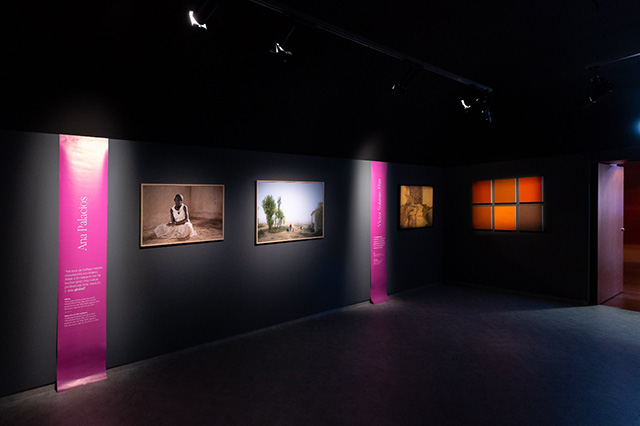
If you have made it this far and you enjoyed it, you should know there is an exhibition available of this project.
Please, feel free to contact me@ana-palacios.com for further details.
Naturalezas contradictorias
Collective exhibition. Espai D’art Contemporani de Riba-Roja de Túria. Valencia (Spain).